
By Serena Lapointe
Leading up to Remembrance Day, five of the community’s schools held ceremonies, bringing
together students, teachers, legion members and youth from the Whitecourt Air Cadets. Each
ceremony was a bit different from the others, with different imagery, music and presentations.
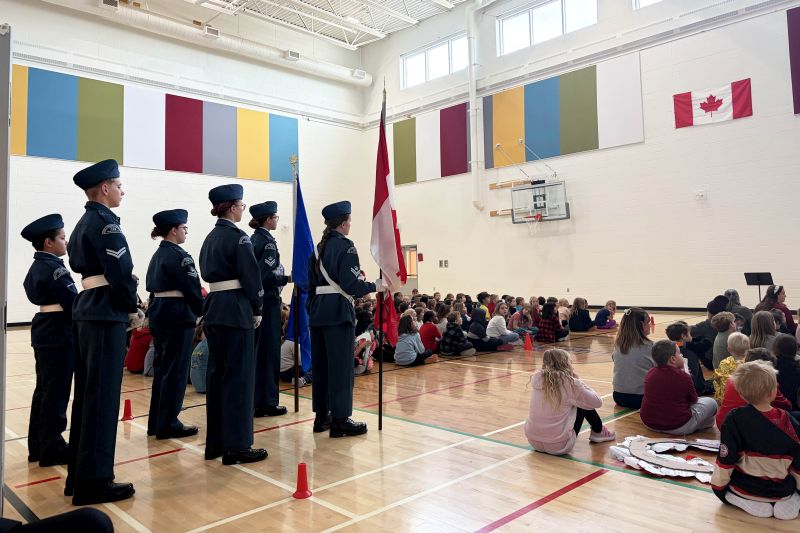
School ceremonies began on Wednesday, November 5, at Ecole St. Anne Catholic School. Six
cadets provided a colour party to start the event, marching forward with a Canadian flag and a
provincial flag, as the crowd of young students watched intently. The group remained in sync as
they took their positions at the front of the assembly.
Flight Corporal Sergeew, 14, was one of the six cadets that morning. She called the experience
a good one. “It was nice to see all the kids taking part in the Remembrance Day ceremony, and
that people can come together and recognize and remember those who have fought for us in
the wars. I thought it was pretty cool to have them see us helping out. I appreciate getting to
give back to my community and being able to do so in a recognized way.”
Flight Corporal Thebeau, almost 15, said it feels special to wear the uniform and to help remind
people of the soldiers who fought for everyone. “I like the opportunities we get to take part in
and the honour of the uniform that we get to wear, and taking part in Remembrance Day
ceremonies. This uniform helps remind people of the soldiers that fought for us, and it’s good for
them to remember and reflect on that.”
Corporal Soderquist, 14, said even though the crowd was young, having the ceremony and
bringing in the cadets and legion members is a good opportunity for the students to begin to
understand what Remembrance Day is about. “It’s a good opportunity for education and helps
them realize and recognize the importance of this day, and why we do this.”
LAC Lefort, 12, is one of the squadron’s newest cadets, and it was his first Remembrance Day
ceremony as a cadet. He said having the kids look up to him and the others was a cool
experience. “It feels nice to have them look up to us. It shows them what cadets do, and maybe
they will want to be like us one day. The kids were all trying to salute us because we were
saluting, which was cool. I’m glad lots of kids attended. It’s good for them to take part in these
ceremonies because it’s important to remember what it’s for, what it means, and not to forget
that soldiers fought for our peace.”
During one of the segments at St. Anne’s, a video was played which showed students
answering what peace means to them. One by one, the youngsters highlighted things like
sleeping in, playing, being with their families and hanging out with their pets and friends. The
answers were pure and innocent.
Upon reflection, Warrant Officer First Class Lapointe said the moment was very emotional.
“Seeing little kids say the things they did, about what peace is for them, and knowing that in a
different world they would quite possibly not be here, shows why it’s important to do this, for
them.” Her eyes welled up as she explained her thoughts. “Their view of peace is so innocent,
and they are blessed to live where they do because they don’t have to wish for those things.
They already have them. The fact that they exist at all means a lot. We must remember that.”
Lapointe has been in the program for six years, having started when she was 12. She said she
remembers being scared the first time she took part in a Remembrance Day ceremony as a
cadet, instead of watching from the audience. “There is a lot of expectation put on you. You’re
representing, in people’s minds, what it looks like to serve, even though you’re just a kid. A lot of
people have never seen a soldier or known a soldier other than seeing them in movies. So,
even though you’re just a cadet, when you’re in your uniform and acting seriously, it doesn’t look
like that. You’re holding people’s expectations for how they see the military.”
She said bringing the cadet experience to schools and helping add to Remembrance Day
ceremonies is something she sees as very important. “Getting to put on a performance of sorts
can interest them and show them that there are kids just like them taking the holiday seriously
and showing their appreciation. I hope that seeing that makes them want to take it more
seriously, too, because it does matter. And doing this reminds them of that,” explained Lapointe.
She added that Remembrance Day doesn’t come with expectations. “You can just show up to a
ceremony, and you’ve already participated in a meaningful way. You don’t have to buy anything.
You just have to show up and listen to people’s stories or stand in recognition or wear a poppy.
It’s not a lot to do and yet it means so much.”
The President of the Royal Canadian Legion Branch 44, Ralph Schutte, was on hand for the
ceremony at Percy Baxter on Friday morning. He spoke highly of the schools for putting on
events and of the cadets. “As a soldier for a long time, I’ve always attended Remembrance Day
ceremonies, and I’m really happy that the schools are carrying it forward, and it’s great to see
the cadets involved. The cadets do a big job for us at the November 11 ceremony because they
carry the flags. A lot of us are older now, and there aren’t many of us in uniform, so the cadets
doing that bit is really helpful for us. They also help us with poppy displays and presentations,
which is really good.”
Speaking to the importance of continuing to have ceremonies, Schutte did not mince words.
“We don’t want to forget, ever. If you’ve ever been to a warzone, you do not want to go there
again. You want to remember that that’s not what we want to have happen. It’s just
indescribable horrors in warzones. If we can manage to convince our youth of that, and also that
they may need to participate if the situation arises, then they won’t forget that.”
Schutte served 32 years in regular service (Princess Patricia’s Canadian Light Infantry &
the
Airborne Regiment) and twelve years in the cadet reserve service. He commanded the Second
Battalion Royal Newfoundland Regiment before retiring. He said it’s important to note that he
and his fellow soldiers were volunteers for their country, including those who joined the Airborne
Regiment and jumped out of planes, as he did.
Schutte said that more people volunteered to be in the Canadian military for WWII without being
forced (i.e. drafted) than in any other country. The Canadian military was entirely voluntary until
1944, when the fear of high casualties brought in the implementation of conscription. He also
noted that 1.1 million Canadians served during WWII, which works out to ten percent of the
population at that time, and only a small portion of those were conscripted. To them we owe all.
We will remember them.


More Stories
Town of Whitecourt selected as one of two Alberta municipalities to take part in pilot project
Jake’s Gift brings story of remembrance back to Whitecourt
Free cornhole program gives Whitecourt youth a place to play