
By Serena Lapointe
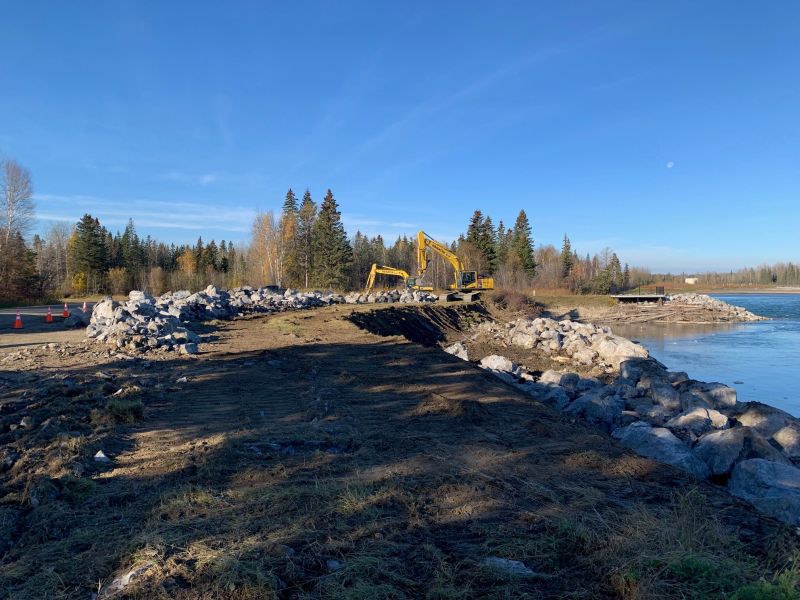
The eleven river spurs that jet out from the banks of the Athabasca River, along Whitecourt’s
boundary, starting from Highway 43 north and continuing downriver to the Whitecourt Golf
Course, were damaged during the 1:100-year flood in 2023, which brought significantly high
waters and debris rushing down the powerful waterway. Although they were damaged in the
process, the spurs did their job to protect the bank, taking on the full brunt of the raging river
and protecting infrastructure and property.
The spurs were identified as a need in 2013 following significant erosion captured along the
banks of the river near the Millar Western pulp property to the northwest of Festival Park.
Following a lengthy preparatory process, the spurs were constructed in 2015 and 2016 and
have effectively prevented erosion since then.
In 2023, when the river raged, the spurs held up their end of the bargain, surviving through the
1:100-year flood they were built to withstand, coming out damaged, but fixable. To get them
back up to 100 percent, ready to take on whatever the river decides to throw at them next, will
take significant dollars.
Thankfully, the Provincial Disaster Relief Program (DRP), under which the Town of Whitecourt
was successful in applying for funding, will cover 90 percent of the project, with the Town of
Whitecourt picking up the tab for the remaining ten percent. To be eligible, municipalities must
have incurred costs exceeding $250,000, which Whitecourt did.
On February 23, Whitecourt Town Council awarded the Athabasca River South Bank Protection
project to McKnight Enterprises for $1,588,739.60 plus GST, and greenlit additional work
required within the limits of the available budget for the program, which is just over 2.2 million
dollars.
A big part of the cost for repairs is the massive rocks used in the creation of the spurs, which
work as a literal wall, fortifying the spur and protecting the bank by redirecting the flow of water
away from the already eroded land, reducing instability and further erosion. Transporting and
placement of the large rocks is time-consuming and involves heavy equipment; however, the
level of protection they provide is invaluable.
Alberta’s Disaster Recovery Program provides one-time funding for municipalities for eligible
natural hazards that occurred during a distinct period and in a specific area. Municipalities have
a short timeline to apply, 30 days from the disaster, or they won’t be considered for funding. The
program recently changed names and is now called HARP, Hazard Assistance and Resilience
Program. Whitecourt’s approval came before the switch.
McKnight Enterprises was the second lowest bidder, just over half a million dollars more than
the lowest bid, from Sublatus for $1,062,715.79. Stantec, the Town’s consultant on the project,
and Administration recommended awarding the project to McKnight, costing just over half a
million dollars more, because the company has experience doing work within creeks and rivers.
“The recommended contractor and superintendent have completed erosion repairs for Alberta
Transportation and other towns in Alberta with similar materials in creeks and rivers. Experience
in creeks and rivers is essential, given the relatively short instream work window of July/August,
and delays could significantly increase costs and schedule. The lowest bidder has some ‘in
water’ experience, but not in a river with the dynamics of the Athabasca,” read the meeting
package. With the 10/90 split shared between the Town of Whitecourt and the Province’s DRP
program, Whitecourt’s cost of going with the higher bid works out to $52,602.38.
Had the Town of Whitecourt chosen to wait to fix the spurs, kicking the can down the road for a
few years, the provincial funding window would have lapsed, leaving the entire cost of the
repairs, as well as the damage that would have occurred while waiting, on the municipality’s
shoulders. “The experience of the recommended contractor reduces the likelihood of future spur
repairs. Though the ranking of the contractors is close and the cost difference substantial, we
believe that awarding the contract to the contractor recommended by our consultants complies
with the terms of the tender and is in the Town’s long-term best interest. “
The work will take place through July and August this summer. The damaged spurs will be
repaired to their pre-flood condition, able to protect the banks from another 1:100-year flood
event, whenever that day comes. Since the current funding model for municipalities is event-
specific rather than location-specific, if and when another significant flood happens, providing
provincial funding remains in place, Whitecourt could apply for future repairs, if necessary.




More Stories
Town of Whitecourt selected as one of two Alberta municipalities to take part in pilot project
Jake’s Gift brings story of remembrance back to Whitecourt
Free cornhole program gives Whitecourt youth a place to play