



By Serena Lapointe
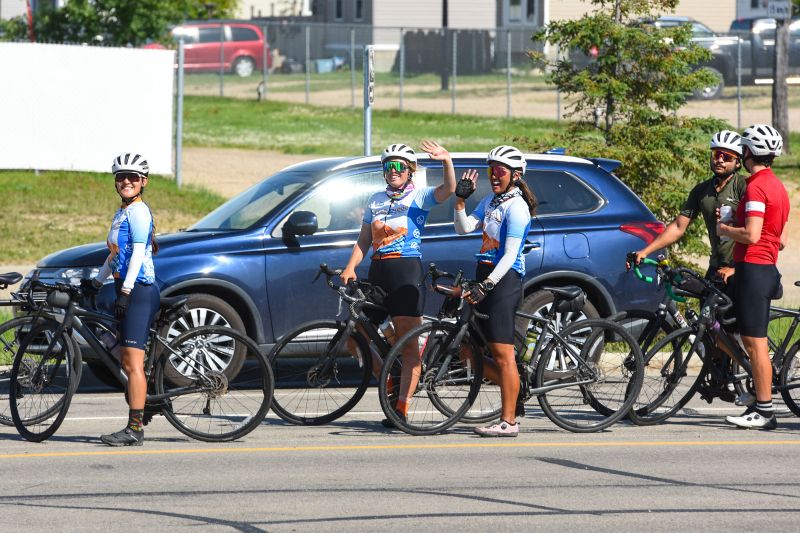
The longest charity bike ride in the world is underway. On Wednesday of last week, the cyclists
on the Ozark Route of the Texas 4000 made a stopover in Whitecourt as they travelled from
Austin, Texas, to Anchorage, Alaska, approximately 4,100 miles (roughly 6,600
km). A journey that takes 70 days to complete.
Each year, students from the University of Texas apply to join an 18-month program to cultivate
the next generation of leaders in the fight against cancer. Riders are empowered to raise
$5,000, ride 2,000 training miles, volunteer, and help plan the ride. Three teams set off, taking
different routes (Sierra, Rockies and Ozark), and meet altogether at the finish line on July 25, in
Anchorage. Their mission is to raise awareness and money for cancer research, share and hear
stories with new friends they meet and spread hope.
The crew rolled into Whitecourt just after 4 pm on Wednesday, July 2, with an RCMP escort to
the Whitecourt & District Taekwondo Association headquarters on 41 Avenue. The first smiling
faces they saw were volunteers from the Whitecourt Cancer & Wellness Society: Janice
Milligan, Joanne Belke, Lesia Hleck, Deb Dizak, and Sam Reid.
Thanks to Mike & Rebecca’s No Frills, Crown & Anchor Pub, Violet-Mae’s Bakery and Mountain
Pizza & Steakhouse, society volunteers were able to feed the hungry group before they hopped
over to the Allan & Jean Millar Centre, which provided passes. Before that, though, the students
had fun with Master Jim Rennie and a few of his taekwondo students. With some practice and
advice on hand placement, the group broke boards, cheering each other on as the pile of
boards grew larger and larger.
Having fun is part of the journey, as they see and try new things, while bringing a message of
hope to those facing cancer and a reminder of the importance of early detection and prevention.
Each rider has their reason for wanting to be part of the gargantuan event, whether they are
riding for a loved one or riding to join a fight worth fighting.
John Kangos, 22, from Austin, Texas, said his reasons for wanting to do it stemmed from family.
“I have had a couple of people in my family pass away from cancer, namely my grandma and
my Uncle Jim. It took a big toll on my family. With more support and help, it could’ve been a lot
better for them,” said Kangos, a realization that now drives him forward.
Claire Levan is twenty and from Dallas. Her neighbour took part in the Texas 4000. “She rode in
the early 2000s, and she always told me that if I went to the University of Texas, I had to do it. It
sounded kind of crazy to me, but, like a lot of people on the team, my family has a complicated
history with cancer. My mom beat breast cancer twice, and she’s such an inspiration and light to
me.”
After applying on a whim, which she says was one of the best decisions she’s ever made,
Levan said the experience has touched her. “The people we meet give us so much faith and
hope for the future of cancer research. Love and community are what we’ve seen throughout
this journey, and how quickly strangers open up their homes to us. The amount of love we are
shown is inspiring. We carry their love and their stories with us to Alaska,” smiled Levan.
Her teammate, Nicholas Mitri, 22, of Houston, said what drew him to the race was a desire to do
something about the big things in life, like cancer. “I was born and raised in Houston, but I
moved to Morocco for six years. Over there, I saw a lot of poverty and issues, and I knew that
when I grew up, I wanted to do something about it. At the same time, my grandpa was going
through prostate cancer, fighting it on and off for ten years. I wanted to find an outlet to do
something.”
The word hope is one he uses often. “We hear lots of stories from people in the communities we
visit, heavy stories with emotion. That’s what we think about when things get hard on the bike.
We have personal connections, too, but we’ve met so many people. They believe that we
inspire them and that we are a symbol of hope, but what I’ve learned is that they are symbols of
hope for us. They make us believe.”
Kangos said the longer they ride, the more they can see the impact it has. “Each community
that we pass through, we only go through it once. It’s a little moment in history that some people
will remember for a long time. It lends a special power to each day and the ride. We are in a
flow state, and sometimes it’s hard to stop and appreciate that. After this is all over and we
process it, I think we will all realize that we were part of something special.”
Mitri agreed. “The network of what we are doing spreads so rapidly when what you’re doing is
out of love.” One of his favourite moments came in Chicago. “We had three events, and one of
them was a presentation from Dr. Kyle MacQuarrie, who works to fight cancer in children at
Northwestern University. It’s a specific role that has some highs, but in my opinion, lots of lows.
It takes a certain kind of person to do that. At the end of the presentation, I asked him how they
instill hope in the children. And he said you don’t. They have to do it for us. I thought about that
for the rest of the week.”
He said finding the strength to keep going seemed to come easier after that. “I’ve tried to tell
myself to never look down negatively on things I do or that other people do, or to believe that
things are always going to end up negative. Every single day, it has echoed in my head.”
For Kangos, one of his favourite moments came early in the trip, as they worked through the
Ozark Mountains. “I was going up this very steep mountain with two other riders, and we had to
dig deep inside of us.” He said the riders suddenly started talking about the people they were
riding for. “For me, that’s my mom. She suffers from bad arthritis and lives in pain.”
As they fought the intense burn in their legs, Kangos said he felt something he hadn’t before. “In
that moment, we were riding for them. Those people were there with us on the bike, going up
that hill. I don’t know if I’ve ever felt a more powerful sense of connection with those people and
my teammates than at that moment.” To support the Texas 4000 riders and their message of
hope, visit www.texas4000.org. To support those suffering from cancer locally, contact the
Whitecourt Cancer & Wellness Society at www.wctcancerwellness.com.



More Stories
Is your fire pit permit older than 2025? Then you need to get a new one
Kenyan delegation may visit Woodlands County this June
Let your voice be heard – Budget Open House happening early next month