



By Serena Lapointe
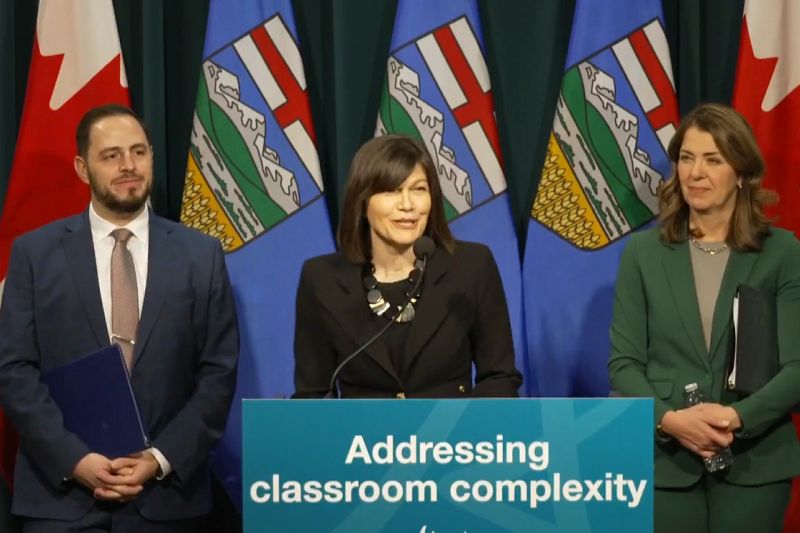
On Friday afternoon, Premier Danielle Smith held a press conference alongside Minister of
Education and Childcare, Demetrios Nicolaides, for the release of the final report from the
Aggression and Complexity in Schools Action Team. The 25-member team comprises
education
leaders, including representatives from school boards in Edmonton and Calgary, the Alberta
Teachers’ Association and other key partners.
Premier Smith said the team consulted numerous education-related stakeholders, including
teachers, occupational health and safety officers, speech language pathologists, psychologists,
organizations, community-based service groups and special interest and advocacy groups.
“What they heard was very concerning,” she said.
The 77-page report from the action team identifies key challenges alongside seven
recommendations to address classroom aggression and complexity. As defined in the report,
aggression refers to “instances of bullying and violence within the school context.” Classroom
complexity refers to “the dynamic and complex system of the learning environment impacted by
the diverse needs of students, including academic, behavioural, social-emotional, linguistic, and
socio-economic factors within the educational setting.”
The report outlined some of the challenges being faced by educators. “The rising numbers of
students with diverse and severe needs is outpacing available supports. Across the province,
qualified professionals such as occupational therapists, speech-language pathologists and
psychologists are raising alarms about the growing number of children with complex needs.”
It went on to explain that rural and urban communities face some different issues and share
others. Rural communities often face limited access to services, while urban areas experience
concentrated needs, more significant newcomer populations, and socioeconomic disparities.
Both deal with chronic staffing shortages, long wait times for assessments and services, and
inconsistent access to qualified professionals, which often results in undiagnosed students or
extended wait periods for necessary interventions.
“We tasked this group with providing immediate and long-term recommendations to the Minister
of Education and Childcare for addressing behavioural, mental health and learning needs in
schools,” said Premier Smith. “The causes of aggression and classroom complexity are difficult
to determine. They can involve academic, behavioural, socioeconomic, linguistic, emotional,
and mental health factors,” she added.
The seven recommendations from the action team fall under one of five categories: safe &
inclusive learning environments, continuum of supports & services, cross-ministry collaboration,
early intervention & ECS supports and professional learning & capacity building.
Under safe & inclusive learning environments, the team recommended the design and
implementation of a comprehensive Inclusive Education Policy Framework, with consistent
provincial guidance. The report states that role clarity is key, “ensuring that expectations are
realistic and sustainable.”
Under the continuum of supports & services, the team had two recommendations: ensuring
children/students have timely access to supports/services and a collaborative approach for
service delivery that includes families and multidisciplinary teams to address students’ needs.
Among others, this includes a formal review cycle every 2-3 years with transparent funding tied
to student complexity indicators, and defined scope and boundaries of the educational system’s
role in supporting clinical and therapeutic needs.
One of the recommendations that Premier Smith pointed to as already in action was within the
cross-ministry collaboration category, which she said they used to create the Class Size and
Complexity Cabinet Committee. “That came from the insights in this report,” said Premier Smith.
This category also includes a cross-ministry Memorandum of Understanding (MOU) between
departments and shared funding models.
Under the professional learning & capacity building category, the action team had several
medium-term recommendations, including streamlining certification for out-of-province and
international teachers, as well as working to standardize practicum phases and certification
requirements with Advanced Education and post-secondary institutions. It includes increasing
staff to support professional learning time for teachers/educational assistants, and the
expansion of mentoring programs for staff development.
The report features a summary of each session held by the action team from which they crafted
their recommendations. Sessions included frontline staff & community organizations, frontline
experts, early learning frontline experts, family & disability organizations, teaching & educational
assistants training programs, and school resource officers &
social services, all of which took
place in the last two weeks of August.
The next steps will see the finalized report given to the Class Size and Complexity Cabinet
Committee, co-chaired by Premier Smith and Minister Demetrios Nicolaides, where resources
can be allocated. Premier Smith said they will be receiving data from school boards across the
province by Monday, November 24 and will meet as a committee twice before the year ends,
adding that they want to get resources out as soon as possible.
“The work is really going to stem from the data that is collected, guided by these
recommendations. What we are trying to do initially is identify the oversized classrooms as well
as the ones that are incredibly complex so that we can get the extra resources to each
classroom,” said Premier Smith.
Also in attendance at the press conference was Joanne Pitman, Chief Superintendent of the
Calgary Board of Education. “While the report does outline significant challenges currently, I
need to state that there are many examples of excellent, outstanding programming and
supports across school authorities. Our system, schools, and professional teams led by our
teachers and classrooms have shown a high degree of commitment to providing strong
programming across a broad range of needs.”
She said that in the Calgary Board of Education area, they have 44,000 students where English
is a second language, which is 31 percent of their student population. “That’s seventeen percent
higher than the rest of the province,” said Pitman. She added that 1 in 5 students in her area
identified with special education needs, and that these were two significant pressure points for
them.
To read the report, visit www.alberta.ca/aggression-and-complexity-in-schools-action-team and
look under Outcomes. Resource allocations are expected to start rolling out in January. Effects
on the local community will be reported on as information is made available.





More Stories
Is your fire pit permit older than 2025? Then you need to get a new one
Kenyan delegation may visit Woodlands County this June
Let your voice be heard – Budget Open House happening early next month