By Serena Lapointe
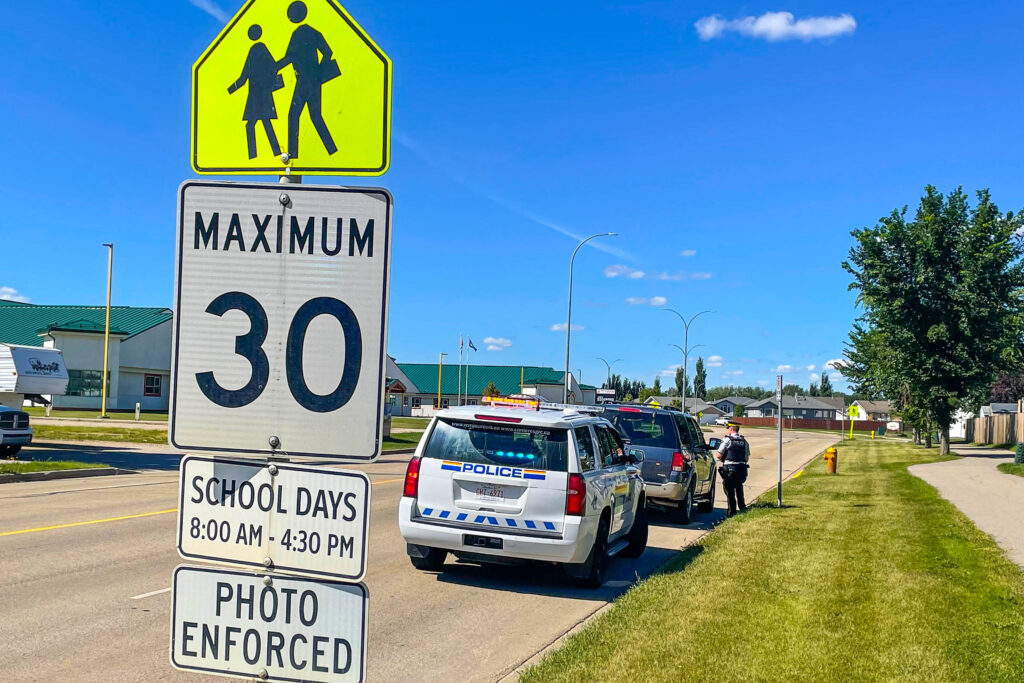
The Automated Traffic Enforcement (ATE) program in Whitecourt looks a bit different
today than it did when it began in 2009. Changes at the provincial level in 2024
removed areas previously enforced, such as the highway corridor, leaving municipalities
with one of two choices for automated enforcement: school zones and playground
zones.
All Mobile Traffic Enforcement Officers are Peace Officers as appointed by the Minister
of Public Safety and Emergency Preparedness. All operations conducted by the
Automated Traffic Enforcement program are done alongside the guidance of the RCMP
and the RCMP Traffic Safety Plan.
Before the allowable zone changes in 2024, Whitecourt used 34 locations for its
program, including priority areas known for higher speeds and locations on the highway.
Now, it uses 25. Depending on where a park or school is located, the peace officer in
the ATE truck could catch traffic coming from one of several directions, each of which
accounts for a location. For example, Central School is flanked by four streets: 52 Ave,
53 Ave, 54 Ave and 49 Street. All directions of travel on those roads could potentially
account as locations, with one focused on a time. Within the report, west/east-bound
traffic on 53 Ave and west/east-bound traffic on 52 Ave were considered four total
locations and used by the ATE program.
From July 2025 to December 2025, the ATE truck spent 68 percent of its time in school
zones and 32 percent in playground zones. The average number of days the truck was
deployed each month was 14.5. The highest month for enforcement activity was
October, with 17 days, followed by August and December with 16. The lowest month to
see ATE enforcement was November, with ten days.
When looking at the data for violation tickets issued by month, one month stood out
amongst the rest: October. During the May 25 Regular Meeting of Council, Councillor
Brian Wynn pointed out the glaring difference. “So, it looks like in October, people were
very bad. Is there any explanation for that?”
Director of Community Safety, Lee Hardman, said there wasn’t an explanation for why
there were 279 speeding tickets handed out in October, with the next closest month
coming in much lower, with 183 (September). “It’s sporadic. I cannot give you a good
idea as to why that is, because again, the number of times they’re operating is around
that 15 to 17 times a month. Forty hours a week is their average, so I cannot justify why
that is higher.”
Councillor Tara Baker said that having the truck in the community is beneficial because
its visual presence matters. “I don’t know how anyone could miss it. There are stickers
on it (the truck), and it’s on the side of the road, so if someone does not see it, that is
unfortunate, but there is no harm in slowing down.”
Mayor Ray Hilts questioned why the municipality didn’t have the autonomy to use the
program in other places. Hardman explained that they could request permission from
the province to use ATE in areas outside of park and playground zones. “We just have
to go through the business case people. We have submitted one, and since the
submission of that document, we have heard from the province that they’re not
entertaining anything until after the summer, when they’re looking at the program again,”
said Hardman. The Town of Whitecourt currently has a business case with the
government, requesting the ability to use an intersection safety device (camera) at the
Highway 43 intersection near IGA.
“It’s unfortunate that we can’t use this as a tool for anything outside of what it says
here,” said Mayor Hilts. “Being able to put this in different places. It’s not just about
school zones, as important as those are. There are obviously other areas in the
community where it would be nice to be able to implement this kind of enforcement.” He
asked his council colleagues if they would support sending a letter to the Minister of
Transportation and Economic Corridors to see about creating a program that is more
flexible to the needs of the community. Council unanimously voted in favour of doing so.
“This is a tool in the toolbox, and I don’t understand why we can’t do that on our own
streets, where we clearly see where it might be needed. If we want to put something on,
say, Flats Road, within town, because we’ve got drag racers and we’ve got people that
are doing stuff there, and it creates a safety issue, then I want to be able to put this unit
there for a couple of weeks and slow it down. That’s just an example (of how to use it).
I’m not saying that’s happening.”
The revenue from Automated Traffic Enforcement Programs is broken down into a
three-way split: approximately twenty-five percent each for the contractor and the
municipality, and fifty percent to the province. In 2025, the local revenue from the ATE
program was just under $20,000.
Due to postal delays with Canada Post and the province, tickets captured in Whitecourt
in 2025 did not start hitting mailboxes until January 2026. As the community uses a six-
month issuance timeline to send out tickets, those captured from January to June 2025
were lost in terms of revenue through the program. The $19,710.53 was mostly
carryover from 2024, which means that 2026 will be the first year with the new
guidelines and full revenue captured in the data.
Dollars collected through the Automatic Traffic Enforcement Program are used to
enhance crime prevention and education through various community events and
projects, and are not used by the municipality to fund basic functions. It is supplemental
only. “The intent of ATE is not to generate revenue. It is for the safety and well-being of
residents and visitors,” explained Hardman. From July to December 2025, there were
802 tickets captured by the ATE program in the park and playground zones of the
community.
Councillor Wynn asked if the community’s peace officers and the RCMP get the data, so
they know where problem areas are. “Absolutely. It is a high priority for both our peace
officers and the RCMP to be in our school and park zones,” responded Hardman. He
added that they are also looking into a new program. “We are looking at introducing a
more heightened program with our municipal enforcement, where it is more targeted-
based. So, that is coming, it’s just not in place yet,” said Hardman.

More Stories
Hilltop students get hands-on look at Alberta’s forestry sector
Blue Ridge Family Fun Day brings an afternoon of fun to the community
Helping local cancer patients, one car show at a time