
By Serena Lapointe
Helen Keller said it best when she said, “Alone we can do so little; together we can do
so much.” In that spirit, the Town of Whitecourt and Woodlands County are teaming up
on a few joint projects, including advocacy, project funding, and provincial
encouragement around two key industry-related topics.
At last week’s regular Whitecourt Town Council meeting at the Forest Interpretive
Centre, an application for funding from the Alberta Community Partnership (ACP) grant
program was up first for discussion. The ACP provides funding for regional collaboration
around new or enhanced regional municipal services, improved municipal capacity to
respond to priorities and effective intermunicipal relations.
Whitecourt and Woodlands County are jointly applying for the grant to update the
Intermunicipal Development Plan (IDP), a high-level planning document that helps
guide growth and development along shared municipal boundaries. Given that
Woodlands County encircles Whitecourt, it’s an important document to have in place. It
is also mandated by the province that adjoining municipalities have one, unless both
agree to not have one. But that is not the case here.
The IDP’s role is to address issues that affect how a community grows and functions
with its neighbouring community. It covers things like land use and planning and
development, such as deciding what can go where and any buffer projects might need
from other developments. It coordinates growth, which could include keeping residential
developments nearer to areas where services are already planned or keeping industry
projects in similar areas, piggybacking off shared resources. Other considerations inside
an IDP include roads and transportation corridors, infrastructure and servicing
coordination, environmental protection, and ways for municipalities to work together
now and into the future.
Having an up-to-date IDP can significantly help with business attraction and investment
through its policy framework, providing certainty and predictability for potential investors,
which can result in reduced financial risk for not only the private business but also the
municipalities involved. Reducing risk helps make an area stand out as a good place to
do business.
The current IDP is from 2013 and is in need of an update. The process of creating the
document is significant and pricey, hence the grant application. From the agenda
package, Woodlands County had estimated the project value at $165,000 and the ACP
grant funds at up to $150,000, alongside a ten percent municipal contribution, which, if
approved, would be a cost of $16,500, to be shared between the two communities.
Woodlands County has applied as the managing partner for the project and, following a
unanimous vote to approve participation, the Town of Whitecourt has joined as the
primary participant. A timeline on when they expect to hear back on it not is unknown at
this time.
The second item discussed concerned a speed transition zone when leaving the
community. When heading north towards Grande Prairie, drivers progress from 70km/h
through the highway corridor in Whitecourt to 100km/h just past the Athabasca River to
the highway’s current 110km/h speed limit. When heading towards Edmonton, the
speed changes just beyond the new intersection at the Kanata, from 70km/h straight
into 110 km/h, with no transition.
Whitecourt and Woodlands County Councils are forwarding a letter together to the
Director of Alberta Transportation North Central Region to suggest that the addition of a
buffer zone be implemented on the approaches into the community, making for a safer
transition from the rural highway to the urban roadway. Should the province eventually
go forward with increasing the speed limit on Highway 43 to 120km/h, a buffer zone
could also reasonably provide safer highway access for county and town residents
alike.
The final joint topic on the docket was on clarity around nuclear energy development
and electrical infrastructure. “The proposed joint letter would request provincial direction
regarding the development and operation of nuclear facilities, the participation of
nuclear generation in Alberta’s electricity market, and planning and funding of
transmission infrastructure and grid connections,” read the agenda item’s summary. The
letter also seeks clarity on whether changes to the existing electricity market or the
funding framework for regulated transmission would be needed. It was not a request for
funding on a specific project.
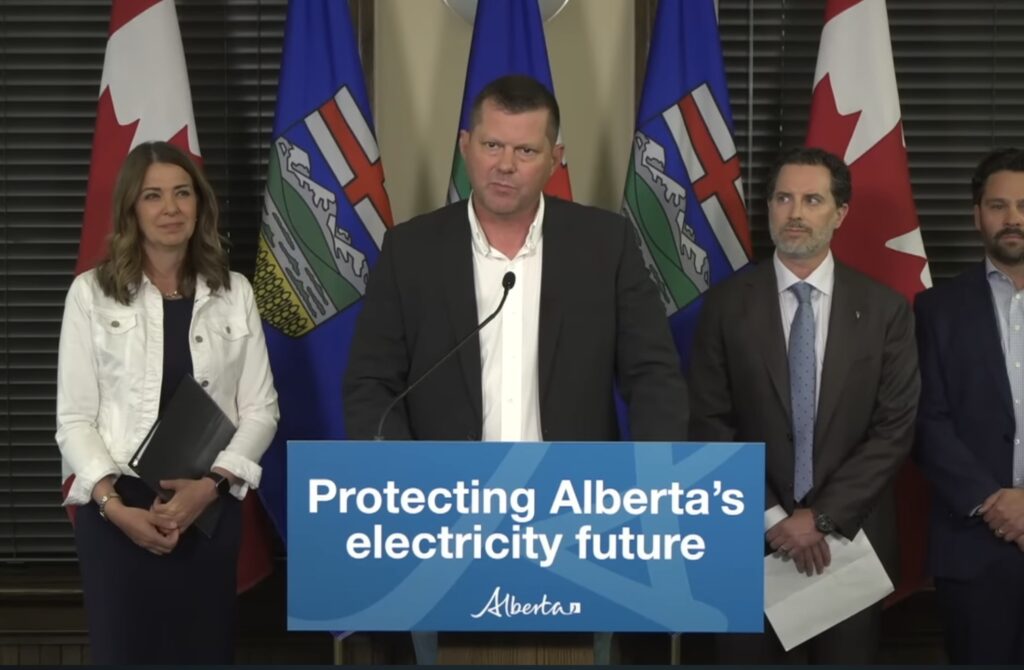
The provincial government does have balls in the air on both topics. On the electricity
side, a massive overhaul of the province’s 25-year-old system is well underway. The
modernization project is managed by the Alberta Electric System Operator (AESO),
which is the independent operator of Alberta’s electricity transmission system. On its
website (aeso.ca), AESO explained that the rollout of changes will happen in phases
starting late this year, through 2027 and early 2028.
The restructuring involves many pieces, but at its core are three main pillars:
Restructured Energy Market, Optimal Transmission Planning and Transmission
Reinforcement Payment. While rules and frameworks are established, the operational
clarity and system integration of each pillar are coming through the phased approaches
mentioned, resulting in some uncertainty as people wait.
Specific to nuclear, the Alberta Government is said to be actively developing policy
around nuclear energy, guided by two phases of engagement so far. The first phase
was in August and October 2025 (4,443 responses), which focused on initial views on
nuclear energy. The second phase took place earlier this year (1,472 responses) and
focused on which issues mattered most and the concerns Albertans had around a
potential nuclear industry in the province.
From the second survey, 67 percent strongly supported nuclear energy development in
the province, while 17 percent were opposed to it in any form. Sixty percent of
respondents shared concerns about radioactive waste management, 56 percent said
they were concerned about safe operations, and 52 percent expressed worries over
potential nuclear accidents. Eighty-one percent agreed that nuclear energy would
improve grid reliability and help keep electricity costs low.
The nuclear policy and framework are expected to be released by the provincial
government sometime next year. The results from the joint advocacy by Whitecourt and
Woodlands County, and any clarity received, will be shared as information is made
public.
Subscribe to our free E-edition
Enter your email once — your free paper will be delivered to you automatically every week.



More Stories
Invisible danger: Whitecourt fire chief shares carbon monoxide safety tips
Rising false alarm calls prompting changes to town bylaw
Whitecourt woman sees first hand the impact of Operation Christmas Child shoeboxes