
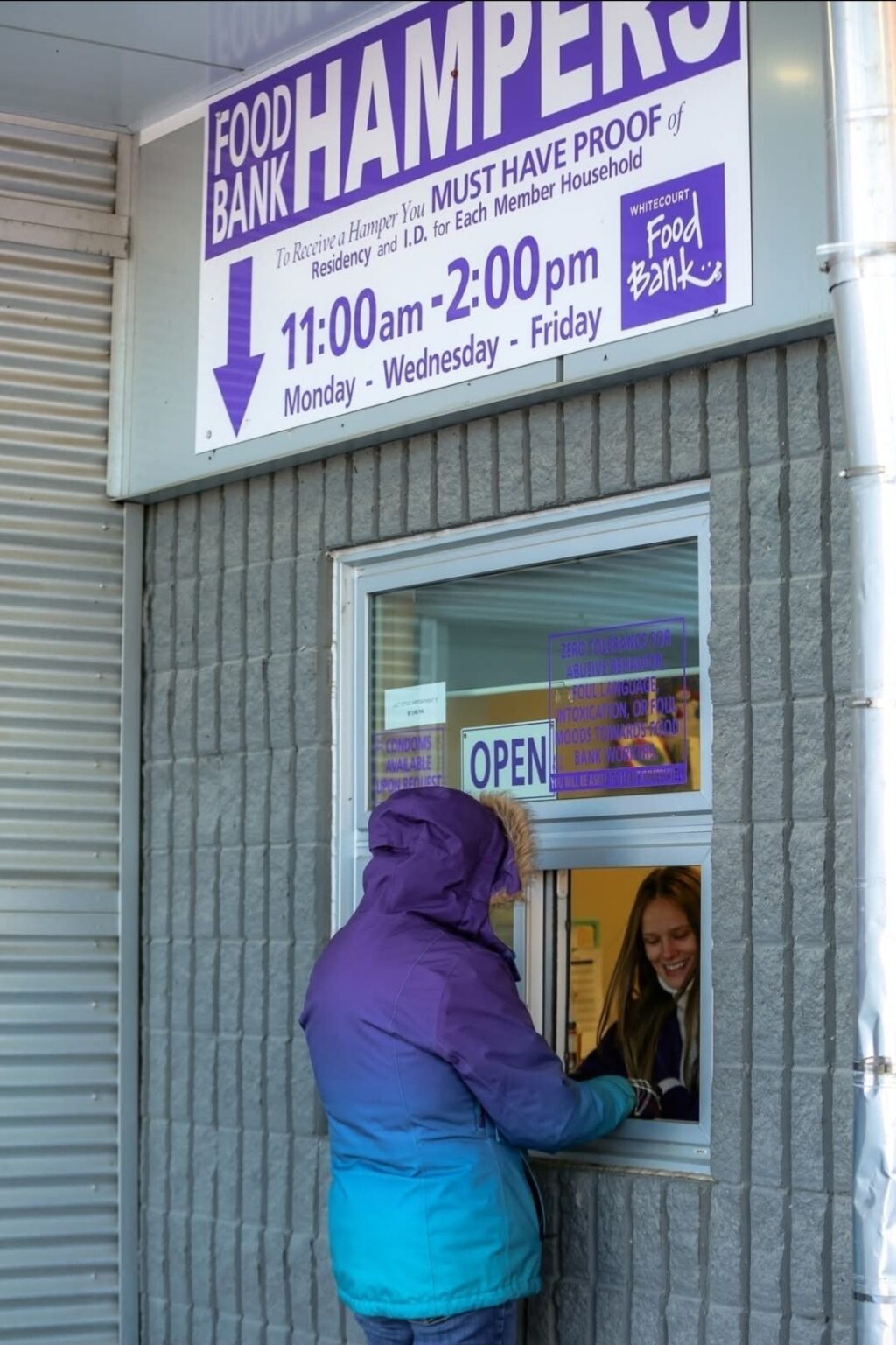
Photo: Town of Whitecourt
By Haylee Winger
Rising grocery prices are putting increasing pressure on household budgets in Whitecourt, with
the local food bank reporting a noticeable increase in the number of people seeking assistance
this year.
The Whitecourt Food Bank currently serves approximately 250 to 300 people each month,
according to Food Bank Coordinator Angela Young. Compared with 2025, the food bank has
seen an additional 435 people access its services this year.
The food bank distributes approximately 120 hampers each month, while its client numbers
reflect individuals rather than households.
Young said higher grocery prices remain one of the biggest challenges facing those seeking
assistance, as families find themselves having to make difficult decisions about what they can
afford.
“As with most Canadians, an increase in grocery prices is the biggest challenge for our clients.
Rising food costs are limiting the amount and type of food families are able to purchase within
their monthly budget. Families are often having to rethink needed items like meat and dairy,”
said Young.
The increase is also bringing people to the food bank who have never needed assistance before.
Over the summer, the food bank welcomed 40 new people, followed by another 26 in September
alone. Young said many of those new clients are seniors and single people who have never
previously accessed a food bank.
“Food insecurity is on the rise and it’s not just for people earning a wage under the poverty line.
Many people who make the average wage in Whitecourt are having to make a choice between
paying bills or buying groceries,” she said.
Young said people living on fixed incomes, particularly seniors, are among those experiencing
significant food insecurity as the cost of living continues to increase while their pension income
remains the same.
Single people are also facing challenges without a second income to help share the costs of rent,
utilities and other living expenses.
While the community has been supportive of the food bank, Young said monetary donations are
currently its greatest need.
Two successful food drives in September and October helped replenish shelves with frequently
needed items, including pasta, beans, soup and other shelf-stable foods.
While food donations help keep shelves stocked, monetary contributions are also essential to
covering the food bank’s operating expenses.
“Monetary donations help with operating costs, keeping the lights on, van repairs, purchasing
bulk food as needed, like meat,” said Young.
The food bank is also looking for several personal care and household items, including two-in-
one shampoo, bar soap, men’s and women’s deodorant, razors, dish soap and laundry detergent in
pods or powder form.
Donations of medium and sandwich-sized Ziploc bags are also appreciated, as the food bank
breaks down larger bulk items such as flour, sugar and rice for distribution.
Young said support from local businesses, schools and community groups continues to make a
difference throughout the year.
Whitecourt Transport assists by bringing the food bank’s monthly allotments from Leduc, while
Petro-Canada and First Choice Car Wash help with fuel and keeping the food bank’s van clean.
Schools also hold annual competitions to collect needed supplies, with participating classes
sometimes competing for prizes by bringing in items such as toilet paper, toiletries and shelf-
stable foods.
Young said last year’s school competition kept the food bank’s toilet paper supply stocked for six
months.
Smaller community initiatives can also have a significant impact. Young pointed to a recent
example involving Central Alberta Rig Welders, which collected just over 510 pounds of non-
perishable food and toiletries after asking attendees at a regional meeting to bring donations.
“Every bit helps, whether it’s donating the $2 ‘wear jeans on Friday’ fund for the month to
donating the proceeds of an auction from a golf tournament, to having a discount day at your
store for people who bring in a non-perishable food item,” she said.
In addition to its regular hamper program, the Whitecourt Food Bank operates a separate
perishables program through a zero-waste initiative with local grocery stores.
Perishable boxes are available on Mondays, Wednesdays and Fridays, with the pickup window
opening at noon. Households can access the program once per week, and boxes are distributed
on a first-come, first-served basis.
Young clarified that the perishables program is separate from the regular hamper program and is
intended to help community members who need a little extra support.
The regular hamper program allows eligible households up to 12 fills per year, with a maximum
of two fills per month. Each fill provides one week of food.
Those accessing the hamper program must provide valid government identification for every
household member, along with proof of residency dated within the previous three months for
each household member over the age of 18. Documentation is required at every intake.
For the perishables program, government identification and proof of residency dated within the
previous three months are required once every three months. Following registration, clients
receive a card with a renewal date, which must be presented at each pickup.
For residents, businesses or community groups interested in organizing a food drive or
fundraiser, Young encourages them to contact the Whitecourt Food Bank directly.
Those interested in supporting a food drive or hosting a fundraiser can reach the food bank at
foodbank@whitecourt.ca.
Subscribe to our free E-edition
Enter your email once — your free paper will be delivered to you automatically every week.



More Stories
“She’s more than just a coach” – longtime head coach for Rivers Rec Gymnastics Club hangs up her clipboard
Invisible danger: Whitecourt fire chief shares carbon monoxide safety tips
Two voices are louder than one